The content of the article below remains unchanged in order to remain a source of information to help affected individuals better understand the issue(s) they may be facing.
We thank you for your understanding and wish you the best with your matter. Please do not hesitate to contact us regarding any other immigration matters you may be experiencing.
What does “prohibited status” (V-List Code J) mean for you?
In essence, being designated as having “prohibited status” in South Africa signifies that you have been deemed a “prohibited person” and are subject to a lifetime ban from re-entering the country.
Several reasons may lead to someone being given “prohibited status”, but the most common scenarios encountered in practice include:
- Prior deportation from South Africa, regardless of the circumstances
- Being apprehended with a fraudulent document, such as a counterfeit visa, passport, or ID — this includes legitimate documents belonging to another individual
Once labelled as “prohibited,” you are permanently barred from returning to South Africa, even for transit purposes. Entry will be denied at any land border post, and you will be refused boarding on any flights destined for or transiting through South Africa.
If you are declared “prohibited”, this is recorded by the Department of Home Affairs (“DHA”) as “V-List Code J”.
As with Undesirable Status, the ban is linked to your personal details, rendering obtaining a new passport, even from a different country, ineffective in circumventing the ban. The sole recourse to address the ban is by submitting a Prohibited Appeal.
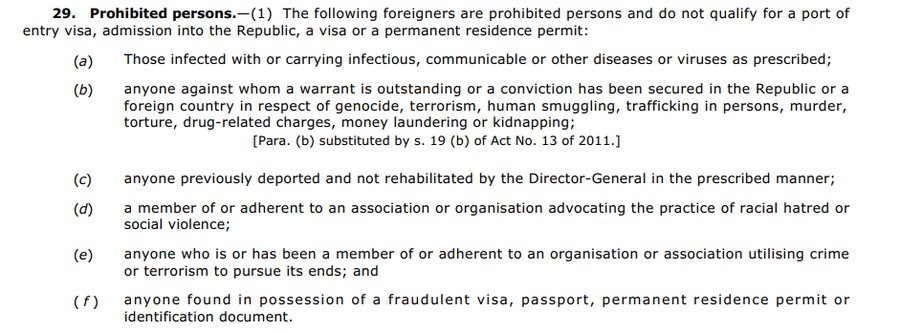
Section 29 of the Immigration Act (Act 13 of 2002) sets out the categories of “prohibited persons” who are barred from entering or remaining in South Africa.
Prohibited Status Appeal — Previously Deported Persons (Rehabilitation Application)
If you’ve previously been deported from South Africa, regardless of the circumstances or whether you were explicitly notified by DHA officials, you are automatically classified as a “prohibited person.” In such cases, before being allowed to re-enter South Africa, you must apply for a Waiver Letter by submitting a “Rehabilitation Application.”
Fortunately, the process of obtaining a Waiver Letter after deportation is relatively more straightforward compared to other scenarios where individuals are labelled as “prohibited.”
If you have been deported, you will need to meet the following requirements for the Rehabilitation Application:
- You need to be absent from South Africa for at least 4 years from the date of your official deportation.
- You will need to provide clear police clearance certificates from your home country and from South Africa.
- Written representations to the Director-General in the form of a sworn affidavit.
Prohibited Status Appeal — Fraudulent Documents (and all other reasons)
If you have been designated as “prohibited” due to being found in possession of fraudulent documentation, or for any of the other reasons outlined in section 29 of the Immigration Act, the sole avenue to potentially regain permission to return to South Africa is by appealing the ban.
Regrettably, cases of “prohibited” status resulting from fraudulent documents are prevalent in South Africa. Many individuals unwittingly obtain visas through improper channels, often facilitated by “agents” or dubious immigration companies who procure fraudulent documents without the applicants’ knowledge.
Often, individuals only become aware of the illegitimacy of their documents when attempting to use them officially, such as updating their visa status with their South African bank or for travel purposes.
While “prohibited” status carries a lifetime ban, individuals subjected to this status retain the right to appeal the ban. However, prevailing with such an appeal is exceptionally challenging, given the DHA’s stringent stance against fraudulent documentation.
To successfully appeal a ban resulting from fraudulent documents, it’s imperative to provide comprehensive evidence demonstrating that you had no knowledge of or intention to participate in the fraud.
To prepare a strong Prohibited Appeal, the following are required:
- A copy of your current passport bio page.
- A copy of the bio page of the passport you were using when you were declared “prohibited” (if different from the current passport).
- A copy of the allegedly fraudulent visa.
- Copies of any official documentation received from the DHA concerning your status.
- Copies of all previous (legitimate) South African visas.
- A detailed rundown of how you came into the possession of an allegedly fraudulent visa.
- Full details of the “agent” you used to obtain the allegedly fraudulent visa — including names, contact details, price paid (and proof of payment), conversation history (email, WhatsApp chats, Facebook messages, SMSs, call log screenshots, etc.).
- Police clearance certificates from South Africa and your home country.
How long do Prohibited Appeals take to be processed?
The DHA typically processes Prohibited Appeals within a timeframe of 30 working days. However, it’s important to note that while the DHA endeavours to adhere to this timeframe, it may not always be strictly followed.
Will you succeed with a Prohibited Appeal?
Each Prohibited Appeal is evaluated on a case-by-case basis by the DHA. However, it’s important to acknowledge the reality that the DHA rejects the majority of Prohibited Appeals.
To maximise the likelihood of success, your appeal must be of the highest possible quality, addressing all relevant facts, and incorporating strong legal arguments supported by compelling evidence.
Despite submitting an appeal meeting these criteria, there is still a possibility that it may be rejected by the DHA. Therefore, it’s crucial to approach the appeal process with thoroughness and diligence, recognising the potential challenges involved.
Have questions about another immigration matter? We’re happy to help.
Contact us →